
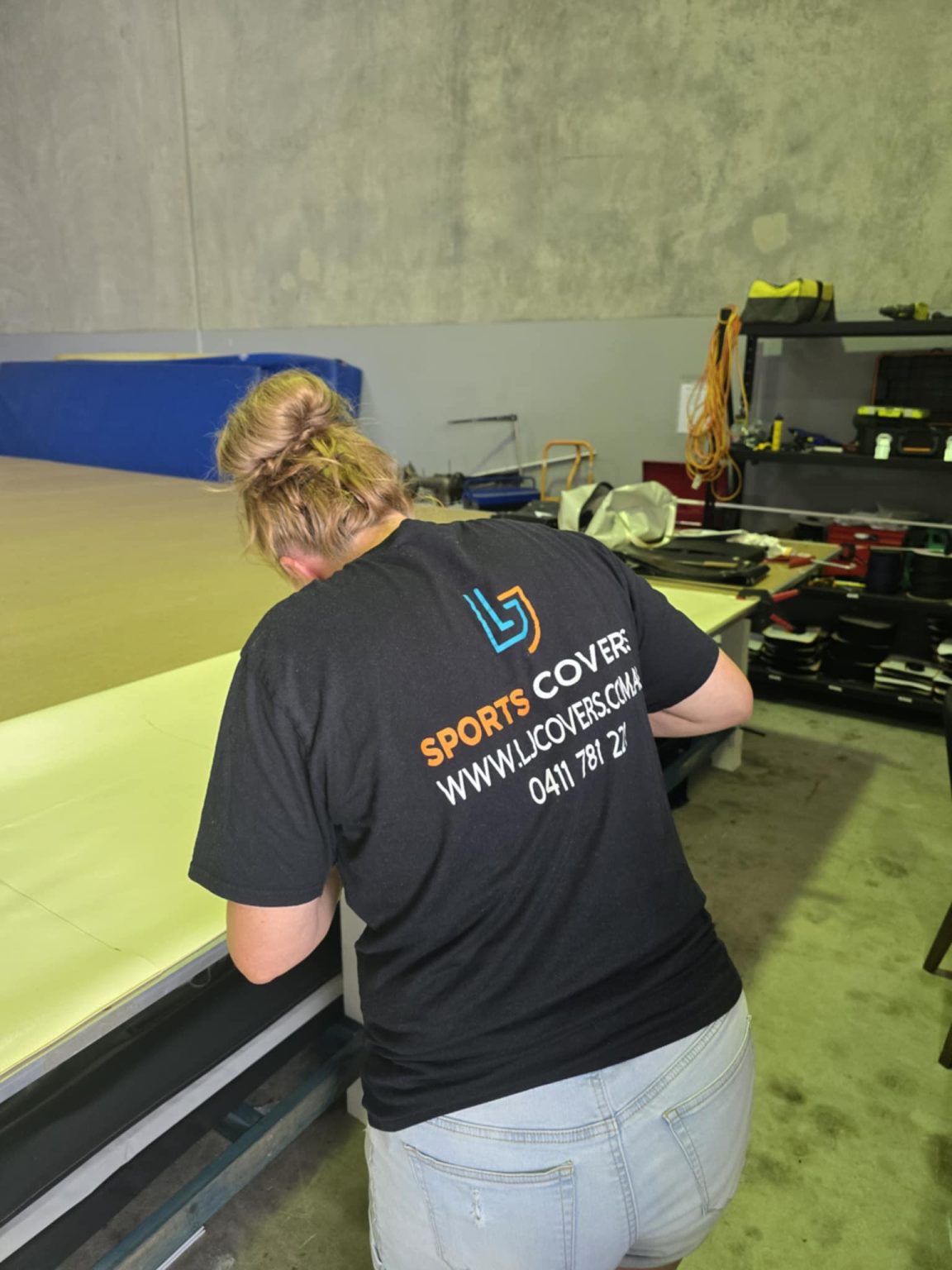
Camper trailers are built for the outdoors, which means their canvas, PVC and other fabric components eventually take a beating from UV exposure, weather, repeated folding, tension, storage and general wear and tear.
At LJ Covers, we regularly assess and repair camper trailer canvas, covers, awnings and related textile components from our Redland Bay workshop.
However, not every tear can be repaired successfully.
One of the biggest factors is something customers often don’t consider:
The damaged section physically needs to fit into our industrial sewing equipment.

Why the Location of the Damage Matters
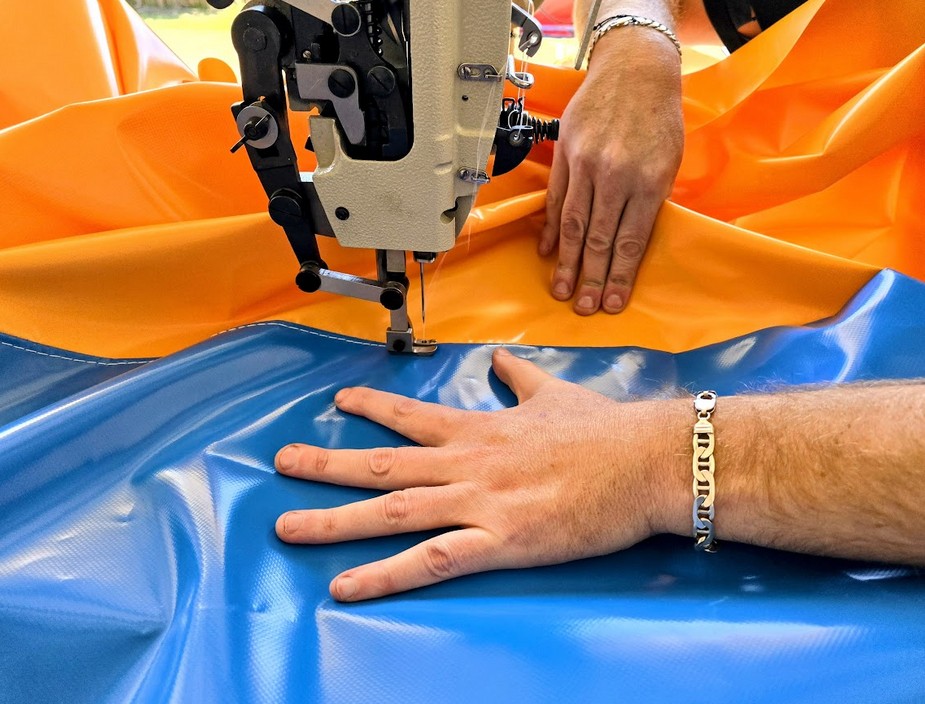
Most heavy-duty camper trailer repairs are completed using industrial sewing machines.
Unlike repairing a small household item, camper trailer canvas can be extremely large, bulky and difficult to manoeuvre.
For us to complete a proper sewn repair, we need to be able to position the damaged area underneath the sewing machine and safely move the surrounding fabric through the machine while stitching.
This is usually straightforward when the damaged canvas section can be removed from the camper.
It becomes considerably more difficult when the damage is:
- high up on the camper trailer
- close to a roof or fixed structure
- surrounded by poles, frames or hardware
- located on a permanently attached canvas section
- unable to be removed or separated from the camper.
If the tear is near the top of the camper and the canvas cannot be removed, there is a reasonable chance that the damaged section simply cannot be physically positioned into the sewing machine.
In those situations, a conventional sewn repair may not be possible.
Can Camper Trailer Canvas Be Repaired While Still on the Trailer?
Sometimes, but it depends entirely on the construction of the camper and the location of the damage.
Small accessible repairs may occasionally be possible without completely removing the canvas.
However, a professional repair often involves more than simply putting a patch over the damaged area.
Depending on the repair, we may need to:
- clean and prepare the damaged section
- remove damaged stitching
- reinforce the surrounding material
- install a backing or reinforcement patch
- sew through multiple layers
- follow existing seam lines
- reseal or finish the repaired area.
That work requires access to both sides of the fabric and sufficient room to manoeuvre the material through industrial machinery.
Removable Canvas Is Much Easier to Repair
If a camper trailer has removable canvas panels, zip-out sections or components that can be detached from the frame, there are generally far more repair options available.
Once removed, we can properly inspect the material on a workbench and determine whether the damaged area can be reinforced, patched or reconstructed.
Being able to remove the canvas also means we can assess surrounding areas that may be starting to weaken.
A tear is sometimes only the visible symptom of a larger problem.
UV-Damaged Canvas May Not Be Worth Repairing
Another important consideration is the condition of the fabric surrounding the tear.
Australian UV exposure is particularly hard on outdoor textiles.
Over time, canvas can lose strength even though it may still look reasonably sound.
If the material has become thin, brittle or heavily UV-degraded, sewing a patch onto it may simply create another weak point beside the repair.
A good repair relies on having strong material around the damaged area for the new stitching to hold onto.
If the surrounding canvas has deteriorated substantially, replacement of the panel or canvas section may be a better long-term option.
What We Need to Assess Your Camper Trailer Repair
Before bringing your camper trailer to our Redland Bay workshop, photographs are extremely helpful.
For the best initial assessment, send us:
- a photo showing the entire camper trailer
- a wider photo showing where the damaged area is located
- close-up photos of the tear or damage
- photos from inside and outside where possible
- the approximate dimensions of the damaged area
- confirmation of whether the canvas section can be removed.
The wider photos are particularly important.
A close-up photograph might show us the tear, but it does not show whether we can actually access that section with our machinery.
Repair or Replacement?
Where practical, LJ Covers supports repairing and extending the life of existing textile products rather than replacing them unnecessarily.
But there is a point where repairing old or inaccessible material becomes false economy.
When we assess camper trailer canvas, we look at:
- accessibility
- fabric condition
- UV deterioration
- seam condition
- location of the damage
- how the canvas is attached
- whether the repaired area will remain under tension
- whether a repair is likely to provide a worthwhile service life.
We would rather tell you that a repair is unlikely to work than charge you for something that will fail shortly afterwards.
Camper Trailer Repairs in Redland Bay
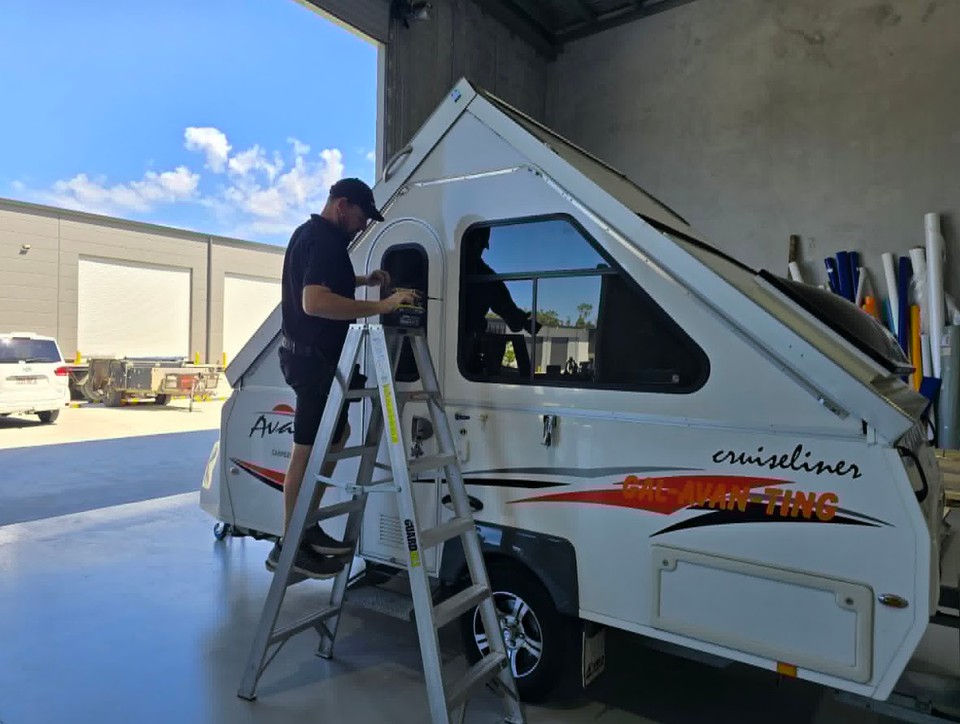
LJ Covers provides custom textile repairs and alterations from our Redland Bay, Queensland workshop.
Our team works with heavy-duty canvas, PVC, mesh and specialist outdoor fabrics across recreational, commercial and industrial applications.
If your camper trailer canvas has been torn or damaged, send us some photographs before bringing it in.
The most important thing to remember is:
If the damaged section cannot be removed or physically positioned into an industrial sewing machine, particularly when the tear is high up on the camper, the repair may not be possible.
Send your photos and details through our website and our team can give you an initial indication of whether the repair is practical before you make the trip.
LJ Covers
Industrial Textile Manufacturing
Redland Bay, Queensland
Two related reads: Avan awnings and annexes, if you are looking at what fits your camper rather than repairing what is on it, and why custom cover projects last longer, which covers the repair or replace decision in more detail.
What Others Are Reading:


Our Services
Contact Us
Contact our team today for a free quote on your custom cover or textile solution.