
A leaking tonneau cover almost always comes down to one of four things. The stitching or seals have broken down, the fabric has lost its tension and holds water, the fixings no longer pull the edge tight, or the fabric itself has stopped keeping water out. Each one leaves a different pattern of wet gear in the tub, so once you know where the water is getting in, you know which of the four you are dealing with.
Wet tools and camping gear are annoying enough, but water left sitting in a ute tub also raises the risk of rust.
- Water along a line in the tub usually means a seam or stitching has given way.
- Water in the middle of the load usually means the cover sags and water pools on top.
- Water around the sides and tailgate usually points to worn fixings or a tired edge seal.
- Damp across the whole cover usually means the fabric or its proofing has worn out.
Why Is My Tonneau Cover Leaking Through the Seams and Stitching?
UV and heat wear down the stitching and seals on a tonneau cover over time. Once the thread weakens or a seam starts to open, water follows the join and drips into the tub after heavy rain. You will usually see it as a wet line in the tub that matches a seam above it.
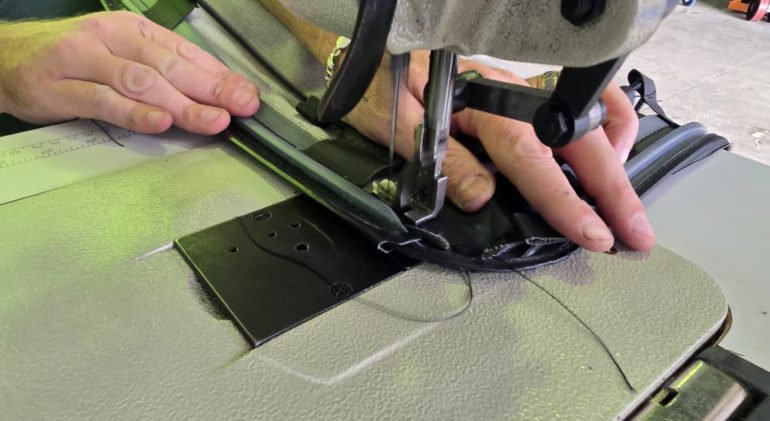
A seam that has only just started to go is one of the easiest tonneau cover repairs to do. We re-stitch blown seams and loose stitching in matching heavy thread so the join holds again. It pays to catch it early, because a seam that is left to open under load puts more strain on the fabric next to it.
Why Does Water Pool on My Tonneau Cover and Leak Through?
A tonneau cover is meant to shed water off its sides. When the fabric has stretched, been over-tightened in one spot, or been left sagging, it loses its shape and a hollow forms in the middle. Rain collects in that hollow instead of running off, and the weight of the water pushes it through the fabric and the stitch holes.
If you find a puddle sitting on the cover after rain, this is the likely cause. A cover that has only stretched a little can often be resized so it sits tight again. A cover that was never cut for your tub in the first place tends to sag again, which is where a custom tonneau cover made to fit your ute makes more sense. We take the measurements off your actual vehicle, including any sports bars, roll bar or ladder rack, so the finished cover sits flat and water runs off it.
Why Does My Ute Tonneau Cover Leak Around the Edges?
Leaks around the edges of a tonneau cover usually come from the fixings. Press studs, bungee cord and hook-and-loop tabs all lose their grip over the years. When they stop holding the edge down firmly, the cover lifts at the sides and tailgate, and rain and road spray get underneath it.
Check each fixing point with the cover closed. A stud that pops off with a light pull, a bungee that has gone slack, or a tab that no longer sticks will each leave a gap for water to get through. Replacing worn fixings is a small repair, and it often stops an edge leak completely. If your ute has an aluminium hard lid rather than a soft cover, look at the seal along its edge as well. A seal that has flattened, cracked or come loose lets water in the same way, and we can look at re-covering or repairing a hard lid too.
When the Tonneau Cover Fabric Itself Stops Keeping Water Out
Sometimes there is no single leak to find, and the whole cover lets moisture through. Canvas and PVC behave differently here. Canvas breathes, which cuts down on condensation under the cover, but it relies on its proofing to keep rain out, and that proofing wears with age and sun. PVC is fully waterproof and wipes clean, but it does not breathe, so a damp load under a PVC cover can sweat.
A canvas tonneau cover that has lost its proofing but is otherwise in good condition can be re-proofed. If the canvas has perished across the whole cover, has cracked, or has gone brittle, a patch or re-proof will not hold for long and replacing the cover is the better option. Our fabric guide explains the difference between canvas, PVC and the other materials we work with, if you are weighing up which one to use for a new cover.
How to Find Where Your Tonneau Cover Is Leaking
The simplest way to find a tonneau cover leak is to recreate the rain. Empty the tub, close the cover, and have someone run a garden hose slowly over it while you watch from inside the tub with a torch. Start at the tailgate end and work forward, so you can see which seam, corner or fixing lets the water in first.
- Mark each leak with a piece of tape on the inside of the cover.
- Check for water pooling on top of the cover while the hose runs.
- Look at every press stud, bungee and tab around the edge.
- Take a clear photo of each problem area in daylight.
A clear picture of the damage shows us a lot before you drive over, and it lets us give you a more accurate idea of the repair.
How to Fix a Leaking Tonneau Cover: Repair or Replace?
Most leaking tonneau covers are worth repairing, as long as the base fabric still has life left in it. Split seams, small tears, worn fixings and a cover that has stretched out of shape can all be fixed. A repair is usually cheaper and quicker than starting again, and we repair covers we did not make, including covers bought elsewhere or second-hand.
Replacement makes more sense when the fabric is cracked, brittle or sun-perished across most of the cover, or when the cover never fitted your tub properly. In that case, repairing one leak tends to move the problem somewhere else. Our repairs and alterations service covers ute tonneau covers and canopies along with trailer covers and tarps, and our canvas repairs page explains the re-stitching, patching and re-proofing we do on canvas and PVC.
Tonneau Cover Repairs at Our Redland Bay Workshop
We repair and make tonneau covers at the LJ Covers workshop at Unit 4/107 Jardine Drive, Redland Bay, for customers across Brisbane and the Redlands Coast. Jason Kemp has spent 25 years fabricating and repairing canvas, PVC and poly-fabric products, and the leaks described in this guide are regular repairs for us. When you bring your cover in, we check the seams, the fabric, the fixings and the fit, and explain whether a repair or a new cover suits your ute better, and why.
To get started, tell us what vehicle the cover is on, what you have noticed and where the water is getting in, and send a photo if you can. If you are unsure whether your cover is worth fixing, call Jason or Leah on 07 3916 4822 or send a message through our contact page.
What Others Are Reading:

Our Services
Contact Us
Contact our team today for a free quote on your custom cover or textile solution.