
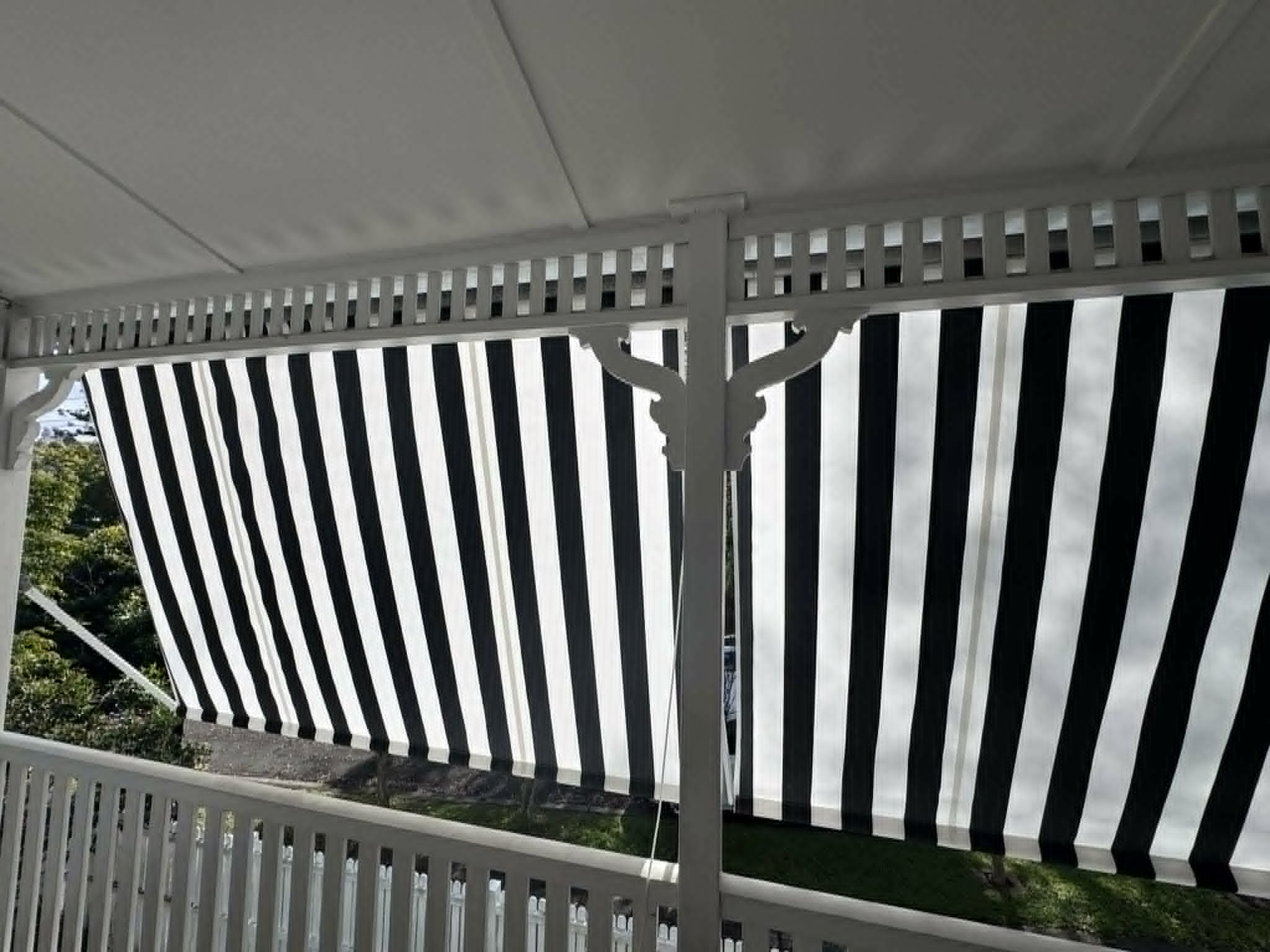
PVC Outdoor Blinds, Mesh or Canvas: Choosing Blinds That Stand Up to Wind and Rain in South East Queensland | LJ Covers
PVC outdoor blinds suit an open patio or alfresco area that needs to stay usable in wind and rain, because clear PVC closes the space to the weather while you can still see out. Mesh outdoor blinds do a different job. They let air through, provide shade and reduce wind impact, but they do not keep rain out. Canvas gives a solid, traditional fabric finish where the look of the blind matters more than seeing through it.
The best outdoor blinds for wind and rain in South East Queensland depend on what you need the outdoor area to do: stay dry, stay breezy, stay private or keep the view. At LJ Covers we fabricate outdoor blinds in PVC, clear PVC, mesh and canvas in our Redland Bay workshop. This guide sets out how each material behaves and where it fits, so you can narrow down the choice before you ask us for a quote.
Key Takeaways
- Clear PVC keeps wind and rain off an outdoor area while you can still see through it.
- Mesh lets air through, reduces wind impact and provides shade, but it is not a waterproof fabric.
- Canvas suits outdoor areas where a solid, traditional fabric finish matters more than a view.
- A clear blind can be made with clear PVC and a mesh or PVC edging, and different sides of one area can use different materials.
- How well a blind holds up in storm season depends on the fit, the seams and the fixing points as much as the fabric.

Which Outdoor Blind Material Suits Wind and Rain in South East Queensland
Start with what the outdoor area has to cope with and how you want to use it. According to the Bureau of Meteorology, Queensland’s severe weather season runs from October to April, and from October to December the east coast, including southern Queensland, has the highest risk of severe thunderstorms. An alfresco area that takes the full force of the wind and rain needs a different blind from a sheltered courtyard that mainly needs shade.
As a starting point, this is how the three materials line up:
- Choose clear PVC when you want the area closed to wind and rain and you still want to see the yard, the pool or the street.
- Choose mesh when you want airflow, shade and less wind impact, and some rain coming through is not a problem.
- Choose canvas when you want a solid fabric finish with a traditional look and you do not need to see through the blind.
- Ask about a combination when one side of the area needs weather protection and another side needs airflow.
PVC, Mesh and Canvas Outdoor Blinds Side by Side
The table below sums up how we use each material for outdoor blinds. It draws on our fabric guide and the material notes on our commercial shade and awnings page.
| What you need | Clear PVC | Mesh | Canvas |
|---|---|---|---|
| Keeping rain out | Yes, PVC is a waterproof material | No, mesh is used where a waterproof fabric is not needed | Depends on the canvas and how exposed the area is, so we talk it through with you |
| Seeing through the blind | Yes, you keep the view | Partly, depending on the type of mesh | No, it is a solid fabric |
| Airflow | No, it closes the space in | Yes, air passes through | A breathable fabric, but a solid panel |
| Wind | Protects against wind as a solid panel | Reduces wind and carries a lower wind load than a solid panel | Acts as a solid panel |
| Look | Clear and open | Screened and shaded | Clean, traditional fabric finish |
| Common uses | Café blinds, patio blinds and weather screens | Shade panels, windbreaks and privacy screens | Patio screens and café blinds where a traditional finish is wanted |
Clear PVC Outdoor Blinds for Keeping Wind and Rain Off the Patio
Clear PVC blinds protect an outdoor area against wind and rain while still letting the light in, so you can use the patio on a wet, windy evening and still see the garden. That is why we use clear PVC for café blinds, outdoor patio blinds and weather screens.
PVC is strong, waterproof and versatile, and it can be welded, reinforced and fabricated into a wide range of shapes and sizes. For a blind, that means we make the panels to the exact opening rather than to a catalogue size, with reinforced edges where the blind is fixed and handled.
Clear PVC can mark, scratch or react differently to heat and handling, so we fabricate it carefully in the workshop to get a good result. If you also want some privacy, reinforced PVC comes in blockout and translucent versions as well as clear, and tinted PVC is another option for café and venue screens.
Mesh Outdoor Blinds for Airflow, Shade and Wind
Mesh outdoor blinds suit areas where you want shade and comfort without closing the space in. Mesh lets air pass through while it still gives you protection, screening or shade, depending on the type of mesh. We use it for outdoor blinds, shade panels, windbreaks and privacy screens.
On a breezy site, mesh has an advantage. A mesh lets through air that a solid panel has to resist, so PVC coated mesh keeps the airflow while it reduces wind and glare, and it carries a lower wind load than a solid panel. If your patio catches the sea breeze or sits on an exposed block, mesh can make the space more comfortable without fighting the wind.
The trade off is rain. Mesh is a good option where a solid waterproof fabric is not needed, so it will not keep a downpour off your outdoor furniture. If staying dry matters, clear PVC or a blind that combines clear PVC with mesh is the better fit.

Canvas Outdoor Blinds for a Solid, Traditional Finish
Canvas has been used for covers and tarps for generations, and people choose it for its appearance, its breathability and its robust feel. On a patio or verandah, canvas blinds give a clean, traditional finish that suits homes and venues where the blind is part of the look of the space.
Canvas is a strong option, but how well it suits your outdoor area depends on the exposure and the finish you want. Acrylic outdoor fabrics are another option covered in our fabric guide, and they are often used for outdoor blinds and awnings where appearance and a professional finish matter. Acrylic canvas is solution dyed for colour retention, and it is breathable.
Canvas and acrylic blinds are solid fabric, so you will not see through them. They are a good fit for the sides of an outdoor area where privacy and a fabric finish matter more than the view.
Combining Clear PVC and Mesh in One Outdoor Blind
You do not have to pick one material for the whole outdoor area. A clear outdoor blind may need clear PVC combined with outdoor blind mesh or PVC edging, and in commercial drop blinds, clear or tinted PVC is used for viewing panels set into a solid blind.
You can also mix materials around one outdoor area. For example, clear PVC can go on the side that faces the weather and mesh on a side that needs airflow, or clear PVC blinds can run across the view with canvas or mesh privacy screens along the boundary.
Tell us which way the weather usually comes from and how you use the area, and we can suggest which material goes on each side.
What Helps PVC Outdoor Blinds Hold Up in Storm Season
The Queensland Government’s advice on preparing your home is to secure loose items that could cause damage if blown around in high winds, so it pays to have blinds that are fitted and fixed properly before storm season starts.
The fabric matters, but the way the blind is made matters just as much, because a strong fabric still needs the right seams, reinforcement and hardware. Depending on the material, we use industrial sewing or hot air, hot wedge or high frequency welding, with reinforced edges, stainless steel eyelets, webbing, rope tracks and D-rings where the blind needs them.
Fit counts as well. Every screen and awning we make is custom measured and fabricated to your exact space, with the correct tension, fixing points and fabric weight. A blind that fits properly performs better and lasts longer than one that almost fits.
When we choose the fabric for an outdoor blind, we look at the weather and wind exposure, the waterproofing you need, the visibility and airflow you want, and how often the blind will be handled.

Outdoor Blinds for Brisbane Homes, Cafés and Commercial Venues
For homes across Brisbane and the Redlands, we make blinds and screens for patios, alfresco areas, large entertaining areas and pool enclosures. A well fitted blind extends your usable outdoor space, reduces glare and heat, and gives you weather protection without closing off the view.
For cafés, restaurants and hospitality venues, we fabricate café blinds and outdoor dining enclosures in clear PVC, shade mesh and canvas. For schools, clubs and other commercial outdoor areas, we make drop blinds and weather screens for spaces that need closing down in bad weather, and installation can be arranged. Our commercial shade and awnings page explains how we work with venues and facilities teams.
Our outdoor blinds, shade and awnings page shows the full range of outdoor blinds, café blinds, patio screens and awnings we make in Redland Bay.
Frequently Asked Questions About PVC Outdoor Blinds
What are the best outdoor blinds for wind and rain?
For an outdoor area that needs to stay dry, clear PVC outdoor blinds are usually the best fit, because PVC is a waterproof material and clear PVC protects against wind and rain while you keep the view. On a very exposed site, mesh lets through air that a solid panel has to resist, so a mix of clear PVC and mesh can suit the area better. We look at the exposure, the size of the opening and how you use the space before we recommend a material.
Do mesh outdoor blinds keep the rain out?
No. Mesh is the material we use where a solid waterproof fabric is not needed. It lets air through, reduces wind impact and provides shade, but rain will still come through it. If you want the outdoor area to stay dry, clear PVC or a solid PVC blind is the better choice.
Can clear PVC blinds be combined with mesh or other materials?
Yes. A clear outdoor blind can be made from clear PVC combined with outdoor blind mesh or PVC edging, and clear or tinted PVC can be set into a solid drop blind as a viewing panel. You can also use different materials on different sides of the same outdoor area.
Is canvas or PVC better for outdoor blinds?
PVC is the better choice when keeping rain out and keeping the view matter most, because it is waterproof and comes in clear, translucent and blockout versions. Canvas is chosen for its appearance, its breathability and its traditional finish. The right material depends on how exposed your outdoor area is and the look you want.
How do I get a quote for PVC outdoor blinds from LJ Covers?
Use the quote form on our website and select Outdoor Shade or Blinds. You can choose a fabric preference such as PVC, clear PVC, mesh or canvas, add the dimensions of the area, and upload photos or drawings. You can also call us on 07 3916 4822 to talk it through.
Talk to LJ Covers About Outdoor Blinds for Your Outdoor Area
You do not need to know which fabric you want before you get in touch. Most people know what they want the outdoor area to do, and we match the material and the way the blind is made to that. Send us your measurements, a few photos of the area and a note on how you use it, and we will recommend a fabric and explain why it suits your space.
Our lead fabricator, Jason Kemp, has more than 25 years in textile fabrication and is the current President of the Specialised Textiles Association. Our outdoor blinds are custom made in our Redland Bay workshop, not imported or made to catalogue sizes.
Call Jason or Leah at LJ Covers on 07 3916 4822, email hello@ljcovers.com.au, or visit the workshop at Unit 4/107 Jardine Drive, Redland Bay. You can also send your details through our contact page.
What Others Are Reading:


Our Services
Contact Us
Contact our team today for a free quote on your custom cover or textile solution.